
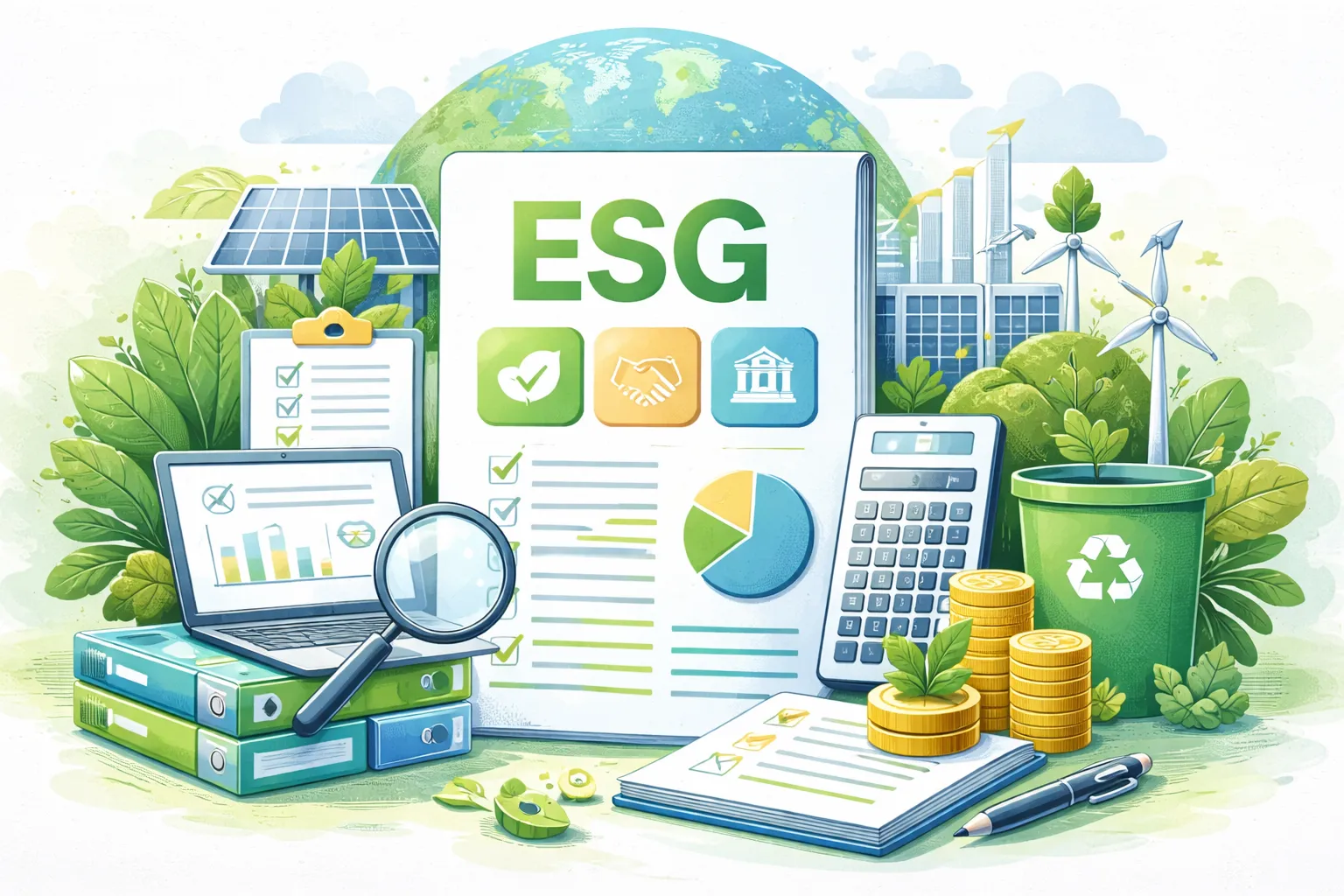
ESG Reporting in Qatar (2026): ISSB (IFRS S1 & S2), QSE Benchmarks, and a Practical Checklist
ESG reporting in Qatar is no longer “nice to have” for many organizations. Clients, investors, lenders, and market bodies are asking for clear, consistent sustainability information—especially around climate risk, emissions, and governance. The good news: you don’t need a complicated system to start. You need a clean structure, reliable data sources, and an evidence pack that stands up to questions.
This guide explains how Qatar businesses can prepare an ESG report aligned with internationally recognized disclosure logic—especially the ISSB standards (IFRS S1 and IFRS S2)—while also using Qatar-specific references like Qatar Stock Exchange sustainability and ESG resources.
What ESG reporting means in Qatar (in practical terms)
ESG reporting is the process of disclosing how your business manages environmental, social, and governance topics in a way that people can compare and trust. In practice, a strong ESG report answers four questions:
- Governance: who is accountable and how decisions are made.
- Strategy: which ESG topics matter to your business model and why.
- Risk management: how ESG risks are identified, assessed, and controlled.
- Metrics and targets: the numbers, the baselines, and the plan to improve.
Many companies start by collecting “everything.” That slows you down. A smarter start is to focus on the few topics that usually matter most in Qatar operations: energy, emissions, water, waste, HSE performance, ethics/compliance, and supplier controls. Then, expand your scope each reporting cycle.
Qatar ESG reporting landscape: what to align with
Qatar has several strong reference points you can cite and align to, depending on your company type and stakeholders:
- QSE benchmarks: The Qatar Stock Exchange sustainability and ESG pages and its Sustainability & ESG Dashboard help shape what listed-company disclosure can look like.
- QFMA guidance: The QFMA guidance on IFRS sustainability disclosures is a practical reference for ISSB-style reporting structure and implementation.
- QCB framework (financial sector): The QCB Sustainability Reporting Framework is aligned to ISSB concepts and is relevant for banks and financial institutions (and also useful as a benchmark for non-financial firms).
- QFC rules (where applicable): The QFC Regulatory Authority updates on corporate sustainability reporting rules are important for entities within the QFC scope.
You do not have to follow every framework at once. Most companies do best with one “core structure” (ISSB-style), then add other layers only when a client, tender, or regulator requires them.
If you’re not sure what applies to your organization, start with a baseline and gap review. A structured audit and gap analysis helps you confirm what you have, what you’re missing, and what to prioritize in the first reporting cycle.
ISSB explained simply: IFRS S1 and IFRS S2
The ISSB standards provide a clear, investor-focused structure for sustainability disclosures. In simple terms:
- IFRS S1 explains the general requirements for disclosing sustainability-related risks and opportunities.
- IFRS S2 focuses on climate-related risks and opportunities (governance, strategy, risk management, and metrics/targets).
If your report follows this structure, it becomes easier to answer the questions that typically come from banks, investors, and large clients: “Who owns this?”, “What changed?”, “How do you know?”, and “What’s next?”
For emissions boundaries and calculation logic, use the widely accepted GHG Protocol Corporate Standard. For broader sustainability impacts and topic coverage, many companies reference the GRI Standards as a complementary layer.
Step-by-step: how to prepare an ESG report in Qatar (without delays)
Step 1: Confirm scope and boundaries
Decide what the report covers: one site, multiple sites, a full group, or project-by-project (common for contractors). Document the boundary logic in one paragraph so your report stays consistent each year.
Step 2: Set governance that can sign off numbers
ESG reporting is not only an HSE task. You need governance that includes operations and finance. Define: an executive sponsor, report owner, data owners (energy, water, waste, HSE, HR), and an approval process. Keep meeting cadence realistic (monthly data check + quarterly review).
Step 3: Build a baseline from evidence you already have
Start with 12 months of utility bills, fuel invoices, waste manifests, and incident logs. Don’t chase perfect datasets on day one. Your goal is to establish a defensible baseline that improves each quarter.
If carbon and emissions are a key stakeholder focus, structure your inventory early. Waey can support the process through carbon management and GHG inventory support.
Step 4: Identify material topics (what matters most)
Material topics are the ESG issues likely to affect your performance or stakeholder decisions. In Qatar, material topics often include: energy efficiency, emissions, water use, waste controls, worker welfare, HSE performance, ethics/compliance, and supplier oversight. Score topics using two lenses: business impact and stakeholder concern.
Step 5: Choose your KPI set and targets
Use KPIs that are measurable and useful for decision-making. Examples: electricity intensity (kWh/m² or per output), tCO₂e for Scope 1 and 2, water m³, waste diversion %, and safety incident rates. Then set targets tied to baseline (12 months is a practical start).
Step 6: Build the narrative (ISSB-style structure)
Write your ESG report in the same order stakeholders read it: governance → strategy → risk management → metrics and targets. Keep statements specific. Avoid claims that you cannot prove with evidence.
Step 7: Create an evidence pack (audit-ready)
Evidence is what makes reporting credible. Set up a shared folder structure and name files consistently. Evidence should be easy to find, not scattered across emails or WhatsApp. If environmental compliance and monitoring are part of your operations, connect reporting to your site controls through an Environmental Management Plan approach.
Need a reporting-ready ESG structure?
If you want a practical ESG reporting plan (baseline + KPIs + evidence pack + report structure), start here: Request a quote.
ESG report template (copy/paste structure)
Use this template as your “one-page reporting plan.” If a line has no KPI owner or evidence source, it’s not ready for publication.
| Area | Disclosure (what you say) | Metric (what you measure) | Target (what you aim) | Evidence (what you keep) |
|---|---|---|---|---|
| Governance | Roles, responsibilities, review cadence, approvals | % data owners assigned | 100% by end of month 1 | Org chart, ToR, meeting minutes |
| Energy | Energy use profile, main drivers, efficiency actions | Total kWh + intensity | -10% intensity in 12 months | Utility bills, meter logs, project records |
| Emissions | Boundary, Scope 1/2 method, reduction plan | tCO₂e (Scope 1 & 2) | Inventory + dashboard by Q3 | Fuel invoices, emission factors, calc sheet |
| Water | Water use, leak controls, reduction actions | m³/month + intensity | -8% in 12 months | Water bills, leak log, maintenance reports |
| Waste | Waste streams, segregation controls, diversion | Tons + diversion % | 60% diversion by year-end | Manifests, vendor receipts, photos |
| HSE | Safety program, incident management, training | TRIR / near-miss / training hours | Improve closure time by 20% | Incident log, CAPA closure proof |
| Suppliers | Supplier screening, data requests, compliance | % spend covered | Top 10 suppliers by Q4 | Questionnaires, contracts, supplier folder |
Tip: Review this table monthly. ESG reporting becomes easier when it’s part of routine performance review.
Evidence pack: what to keep (so your report stays credible)
If a stakeholder challenges your numbers, evidence is what protects your report. Build an evidence pack for each KPI, with consistent file naming. Here’s a practical evidence list that works for most Qatar companies:
- Energy: electricity invoices, meter readings, HVAC maintenance logs, project completion records.
- Fuel and fleet: fuel invoices, vehicle lists, odometer logs, generator run-hours (if applicable).
- Waste: manifests, vendor receipts, waste contracts, photos of segregation controls.
- Water: bills, meter logs, leak incident log, repair records.
- HSE: incident register, corrective actions, training records, risk assessments.
- Governance: committee terms of reference, meeting minutes, sign-off evidence.
- Supplier ESG: questionnaires, contract clauses, supplier audits (if any), follow-up emails.
If you want your climate section to match stakeholder expectations, keep emissions methods consistent and reference your accounting basis, such as the GHG Protocol Corporate Standard. This doesn’t make your report perfect— it makes it explainable.
Common mistakes in Qatar ESG reports (and how to fix them)
Mistake 1: Writing strong claims without evidence
If you state “we reduced emissions,” stakeholders will ask “by how much, using which boundary, compared to which baseline?” Fix: include baseline year, method, and evidence references.
Mistake 2: Using too many frameworks in year one
Teams try to satisfy ISSB, GRI, and every client template at the same time and get stuck. Fix: choose one core structure (ISSB-style is a strong start), then add other requirements only where necessary.
Mistake 3: KPIs that don’t match the business
Generic KPIs that don’t connect to operations make the report feel artificial. Fix: choose KPIs linked to cost and risk (energy, water, waste, safety), then expand to supplier data and broader impacts.
Mistake 4: No internal ownership
An ESG report is not a “one-person project.” Fix: assign data owners and ensure finance/compliance can verify the numbers.
Mistake 5: Supplier data ignored until the last minute
Fix: start small—top suppliers by spend—and grow your coverage each cycle.
FAQ
Is ESG reporting mandatory in Qatar?
Requirements depend on your regulator, listing status, and stakeholder obligations. Many organizations still report voluntarily, but market and regulatory guidance in Qatar increasingly references ISSB-aligned disclosure logic for decision-useful reporting.
Do SMEs in Qatar need ISSB-style reporting?
SMEs are not always required to publish ISSB-based disclosures. However, using an ISSB-style structure (governance, strategy, risk management, metrics/targets) makes it easier to respond to client and lender questionnaires.
What is the minimum ESG KPI set to start with?
A practical starting set is energy (kWh and intensity), Scope 1–2 emissions (tCO₂e), water (m³), waste (tons and diversion %), and safety incident tracking. Add supplier ESG coverage as your next layer.
How long does it take to prepare an ESG report?
Many companies can prepare a first credible report in 8–12 weeks if boundaries are clear and data sources are accessible. Your second report usually takes less time because the evidence pack is already structured.
ISSB vs GRI: which one should we use in Qatar?
ISSB (IFRS S1/S2) is often used for investor-focused disclosure structure. GRI is widely used for broader stakeholder impact reporting. Many organizations use ISSB as the core structure and reference GRI where it strengthens topic coverage.
Can Waey support ESG reporting end-to-end?
Yes. Waey can support baseline and gap reviews, KPI setup, evidence pack structure, carbon inventory planning, and report-ready documentation. Start here: Request a quote.
Back to top: ↑